
Hebe Unwin
Lecturer
Department of Human Sciences, Society & Culture
01752 636700
hunwin@marjon.ac.uk
Role Summary
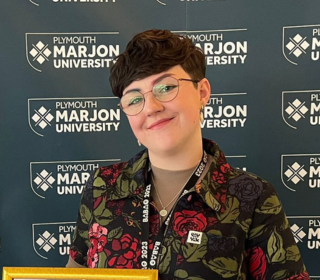
Hebe is a Lecturer in the Department of Human Sciences, Society & Culture, and a module leader, dissertation supervisor & personal development tutor for BSc (Hons) Forensic Investigation. They lead a variety of modules across the programme, primarily in biological facets of Forensics. Their specialism is in the recovery and identification of human remains in both modern and historical populations, with experience working with human skeletal remains, and at archaeological dig sites both in the UK and abroad.
Their research focus at present is in smile photography analysis as a means for human identification, forensic taphonomy, and pedagogic practice in forensic teaching provisions, particularly in dissertation projects.
They are a neurodiverse academic with a passion for EDI work, as well as widening participation and inclusion.
Qualifications
Hebe holds a BSc (Hons) in Forensic Biology from the University of Chester, an MSc in Forensic Anthropology from Liverpool John Moores University, a Post Graduate Certificate in Academic Practice from Plymouth Marjon University, and an Associate Fellowship with the Higher Education Academy (HEA).
Teaching
You’ll find Hebe teaching on a variety of modules across the BSc (Hons) Forensic Investigation programme, including Anatomy and Physiology, Forensic Science, Forensic Anthropology, Outdoor Investigations, Mass Disaster Victim Identification, and more.
They also supervise dissertation research on the Honours Project module across level 6, overseeing student research primarily relating to forensic biology, taphonomy and entomology.
Research
Hebe’s research interests are in disaster victim identification, particularly within the field of smile photography analysis, where they are assessing & validating the use of non-clinical images of smiles to identify unidentified persons, and whether a standardised practice could be introduced, as at present only case studies have been documented, and evidence of the method’s use is limited. They are a professional on the physical evidence working group of the COST Action CA22106, titled 'Migrant Disaster Victim Identification', which is a European research network that aims to improve the identification of deceased migrants
In addition to this, Hebe is currently exploring pedagogic practice within Forensics, having recently produced a report addressing how final year projects could better serve the Forensic community through the introduction of researcher-practitioner partnerships.
Publications
BABAO Conference Poster on Intentional Dental Modifications in Historic & Modern Day Europe
Expert Membership of professional bodies
British Association for Biological Anthropology and Osteoarchaeology (BABAO)
British Association of Forensic Anthropology (BAFA)
Chartered Society of Forensic Sciences (CSFS)
Royal Anthropological Institute (RAI)
Roles on external bodies
Team member & volunteer archaeologist for Cranfield Recovery & Identification of Conflict Casualties (CRICC).
Expert within Working Group 1 (Physical Evidence) of COST Action CA22106, Migrant Disaster Victim Identification.
Peer reviewer for the Canadian Society of Forensic Science Journal.
Share this page on

