

BSc (Hons) Football Science / BSc (Hons) Football Science with Professional Practice Year
Begin your journey as a future football scientist here. Develop the skills you need for a career in football focusing on player development and team performance. This specialised course offers expert teaching, training in practical skills, built-in professional qualifications and an optional one year professional industry experience.

Open for Clearing. Open for You.
This course is ready when you are! Apply through Clearing today to secure your space.

Opportunity to study with a real-life, hands-on professional practice year

Entry requirements
Three A-levels at grades BCC - BBB
BTEC DMM - DDM
Access to HE Diplomas accepted with credits in line with the UCAS tariff point range
Or T level M
GCSE English Language at Grade 4/C or equivalent
Applicants with other qualifications and/or experience will be considered on an individual basis
We will accept 2 AS levels in lieu of one A level but must be accompanied by 2 A Levels or BTECs (General Studies is excluded).
UCAS points 104 - 120
UCAS code FBS1 without placement year or FBS2 with placement year
UCAS institution code P63
Duration Three years full-time or four years full-time with the optional professional practice year, or up to six years part-time
Any questions?
Contact Charley, our Applicant Support Coordinator, if you have any questions. Email: applicantsupport@marjon.ac.uk and Charley will get back to you!
Course Summary
BSc Football Science has been developed in collaboration with football industry professionals. It offers an outstanding quality of education alongside the skills and expertise required to work in football.
You'll learn to support individual player development and team performance. Additional professional qualifications are embedded in the course at no extra cost, including Gym Instructor, Personal Trainer and Strength and Conditioning Trainer. These enable you to develop specific, vocational and academic skills that support career development. Furthermore, you will be encouraged to undertake work-based learning with our network of football industry partners.
BSc Football Science degree teaches you to apply scientific principles to all aspects of athletic development across the age appropriate phases of player development. There is a strong emphasis on practical learning and how to apply these scientific principles to player or team performance.
It is taught by highly qualified academics and industry professionals who are employed in the football sector, enabling students to benefit from their knowledge and experience.
You will gain practical knowledge and understanding across the sport science disciplines in our dedicated sport science laboratories. Our physiology laboratory is the only in the South West to be accredited by the Chartered Association of Sport & Exercise Science (CASES). It draws elite athletes from across the region and students get valuable experiences from working with them.
BSc Football Science includes an optional professional practice year. You have the opportunity to gain industry specific skills by working within applied football setting. It increases your knowledge of the sector, provides relevant work experience and develops your personal network in the football industry. The professional practice year is available after your second year and you then return to university for the final year of teaching.

Why this course at Marjon?
State of the art sport and exercise science lab - accredited by CASES
Gain additional professional qualifications (at no extra cost)
Field trips to see football science in practice within high performance settings
Opportunities to earn while you learn, as a student colleague
Learn with our professional football partners
Practical hands-on experience working with players as part of a multi-disciplinary team
Modules for this course
1st Year
Your journey to becoming a scientist
The sporting mind
Mechanics of human movement
Exercise and conditioning
Laboratory and field techniques in physiology
Research and academic skills
2nd Year
Applied analysis of human movement
Growth and maturation: Applied considerations for the football scientist
Player performance: Monitoring, evaluation and intervention
Multidisciplinary approaches for performance
Work-based learning: Sport sciences
Research design and analysis
3rd Year
Honours project
Interdisciplinary practice in sport and exercise
Conditioning, rehabilitation and return to performance
Player data science for performance optimisation
Player pathway to performance
This course is perfect if you’re curious about
How does a performance analyst support technical and physical performance coaches?
What scientific principles influence talent identification and player development in football?
How does football science supports the FA England DNA and the FA four corner model?
What are the key physical, psychological and sociological differences between men and women footballers?
How does biological maturity impact on player development?
How can I support players and coaches to improving performance or reduce injury risk?
What might you become?
BSc (Hons) Football Science will prepare students for graduate careers by gaining transferable skills that employers require. Career opportunities include physical performance coach, performance analysist, sport scientist, talent identification and recruitment in a range of professional football environments.
Employment prospects in the football industry offer graduates to work within a variety of different professional environments. Some employment opportunities will be age range specific, whereby you will work as part of a multidisciplinary team or department. Graduates from this degree can also progress to postgraduate study.
See where our graduates are now
Working with:

Plymouth Arygle Football Club (PAFC)
Plymouth Argyle are an English League One football club. We work with both the men's and women's squads at our Sport & Health Centre on campus.
How you’ll be taught and assessed?
How will you be taught?
Teaching includes a combination of workshops, seminars, workshops, tutorials and practical experience within our high specification sport science laboratories. Work placements will also be undertaken.
How will you be assessed?
Assessments take place through lab reports, practical assessments, posters, case studies, e-portfolio and by creating your own website.

Chris has over 20 years experience as a football practitioner and has worked supporting players in a variety of football contexts from grassroots to elite. He has worked with The Football Association (FA), Plymouth Argyle FC, Plymouth Argyle Women's FC and is closely involved with the FA Women’s High Performance Football Centre.
Fees and funding
Fees UK students: £9,790 per annum
This fee covers your tuition and access to course-specific equipment and facilities, as well associated services including access to the library, study skills support, IT support, student support and wellbeing services and membership of the Student Union. There may be additional costs by course.
Additional costs:
You'll need to cover the following additional costs:
- A DBS check is required
- You'll need a Marjon sports kit
- Some students opt to fund related qualifications or student memberships of external organisations
Funding available for this course
Our Student Funding Advisors offer confidential and impartial advice about your funding options.
Learn moreLecturers

Ben, currently undertaking a PhD specializing in vertical jump force-time analysis; monitoring and enhancing performance. He is also a Sport Science Officer lecturing in applied biomechanics and strength & conditioning.



Melissa has research interests that include increasing self-awareness and positive growth and mental health, developing confidence and emotional control, reducing anxiety, and facilitating communication.

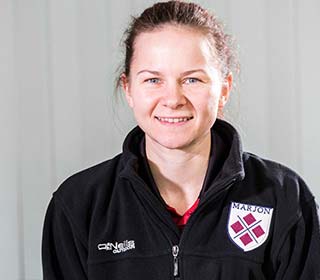
Vicki specialises in exercise rehabilitation and has worked with diverse groups including adolescents, sports people, disabled athletes, fire service personnel and sarcoma patients.

Sophie, who plays pool for England, teaches sport and exercise psychology principles and how these can be applied to improve sport performance and wellbeing.

Ben has more than 20 years experience working in various health and fitness roles. In this time he has worked with more than a thousand participants and helped train hundreds of fitness professionals.

Pille is a lecturer in Sport and Exercise Psychology and she teaches across a range of undergraduate and post-graduate sport programmes.

Chris is Manager of the Sport and Health Science Laboratory.
More information
Further lecturers include:
- Isabel Szembek
- James Hedges
To keep up to date or see what we are getting up to on our course, follow us on Instagram.
Find out more about studying BSc (Hons) Football Science at Marjon
Share this page on


Open for Clearing. Open for You.
This course is ready when you are! Apply through Clearing today to secure your space.